


In a year marked by war, uncertainty and mounting pressure on public institutions, ten young people chose not to stand on the sidelines.
Instead, they stepped into Lebanon’s public institutions, working alongside ministries and public officials to address some of the country’s most pressing governance challenges through the Youth4Governance programme.
Over six months, two cohorts of interns helped turn ideas into practical tools, institutional knowledge and working solutions. Their experience showed that, even in difficult times, innovation and public service can continue — and that young people can play a meaningful role in strengthening the institutions Lebanon needs.
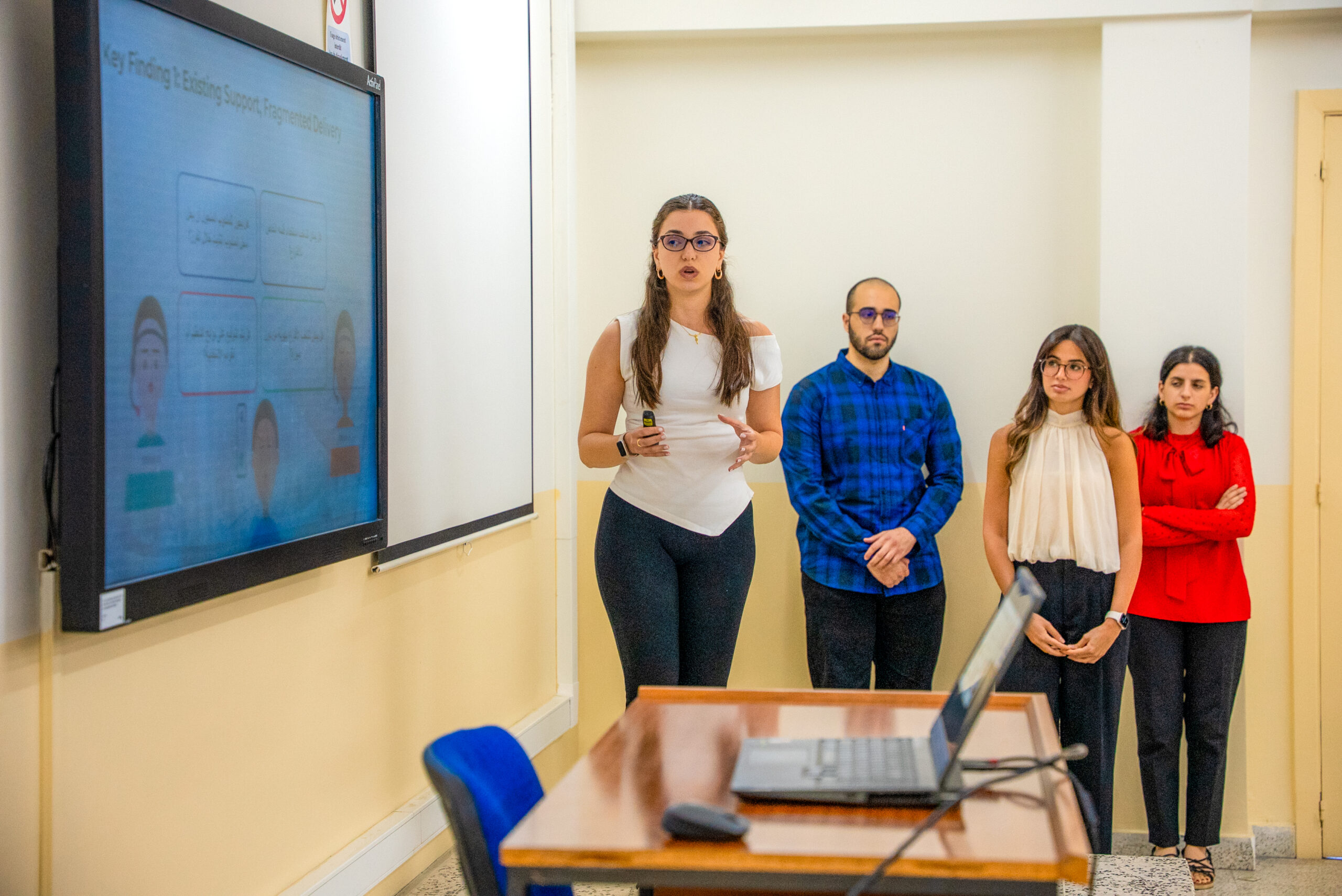
On 15 June, their journey culminated in a closing ceremony at Saint Joseph University’s Faculty of Law and Political Science. Students, professors, public officials and members of the Y4G ecosystem came together to celebrate not only the completion of individual projects, but a wider vision of what youth can contribute to Lebanon’s future.
The ceremony created space for dialogue, reflection and inspiration. It highlighted the importance of innovation, public service and youth leadership at a time when Lebanon’s institutions are being asked to respond to overlapping political, economic and humanitarian pressures.
Reimagining Electoral Governance
Democracy depends on strong institutions. But managing elections is complex. It requires legal clarity, operational coordination, public communication and trust.
Working alongside the Ministry of Interior and Municipalities, the first Y4G cohort set out to support Lebanon’s electoral system from within.
Their work ranged from building a comprehensive database of electoral legislation to creating a detailed electoral calendar that maps responsibilities, deadlines and key milestones across the election cycle. They also developed policy proposals to facilitate out-of-country voting, helping to support broader participation in the democratic process.
Recognising the importance of sustainable institutional knowledge, the team developed a Parliamentary Electoral Framework: a practical guide to support the planning and management of parliamentary elections. To help ensure that this knowledge remains accessible beyond the internship, they also designed a Parliamentary Electoral Training Programme, which has since been digitised for continued use by ministry staff.
The Y4G fellows also explored how technology can support better governance. They introduced a media-monitoring platform to help automate information tracking, and developed an AI-powered multilingual chatbot capable of providing citizens with round-the-clock support and information while generating useful insights for the Directorate General of Civil Status.
Their message was clear: stronger institutions are built not only through laws and procedures, but through the practical tools, knowledge systems and innovations that help public officials deliver.
Making Sense of Crisis: The Story Behind AMAN
In moments of crisis, security and crisis-response institutions are often flooded with data from media platforms, field reports, digital channels and public sources. Yet decision-makers can struggle to transform this fragmented information into clear, timely and actionable insight.
This challenge inspired the second cohort’s flagship project: AMAN — Analyze, Monitor, Anticipate, Navigate.
During the closing ceremony, the team invited participants into an interactive crisis simulation. The exercise quickly revealed a familiar reality: critical information is often scattered across platforms, reports and communication channels. When decisions need to be made quickly, this fragmentation can make it difficult for institutions to see the full picture.
AMAN was designed to bridge that gap. The platform brings together information from multiple sources and helps transform fragmented data into operational insight. Through AI-powered analysis, interactive mapping, automated reporting, risk monitoring and image verification tools, AMAN equips institutions with tools to navigate uncertainty, strengthen preparedness and respond more effectively to misinformation.
Behind the platform were months of research, consultations and problem-mapping exercises aimed at understanding the root causes of information gaps within crisis-response systems.
The result is a novel approach to institutional preparedness that recognises that serving citizens during both war and peace depends on the ability to act on timely, reliable information.
Sofra: Turning Solidarity into a System
When the war intensified in March 2026, humanitarian needs surged across Lebanon. Families were displaced, shelters came under pressure, and access to hot meals became an urgent daily concern. At the same time, Lebanon’s restaurant sector — already weakened by years of economic crisis — faced another severe shock.
The question was simple: could a response be designed that supports vulnerable communities while also helping local businesses stay active?
The answer was Sofra. Developed in partnership with the Ministry of Tourism, Sofra is a digital coordination platform that connects donors, restaurants, shelters and NGOs. Through the platform, donors can fund meals, restaurants can prepare them, and delivery to verified shelters can be coordinated and tracked.
In doing so, Sofra created a bridge between humanitarian response and local economic resilience. Restaurants were able to use their kitchens, staff and supply chains to prepare meals for people in need, while shelters and NGOs gained access to a more structured and accountable way of coordinating food assistance.
Within days, Sofra had collected more than USD 125,000, enabling the distribution of over 41,000 meals.
Yet what makes Sofra important is not only its humanitarian mission. It is the system behind it. The initiative brings together public institutions, private-sector actors, humanitarian organisations and international partners around a shared response. It is designed to help ensure that assistance is delivered efficiently, fairly and transparently.
To build trust among all stakeholders, Sofra incorporates governance and accountability mechanisms, including verification processes, field visits, audits, digital tracking and continuous monitoring. Restaurants report deliveries through the platform, shelters provide feedback, and the system helps route support where it is needed.
In a context where trust in institutions is often under pressure, Sofra demonstrates the centrality of transparency for effective humanitarian action. It also shows how digital tools can help turn solidarity into a system — one capable of supporting people in crisis while strengthening coordination between the state, civil society and the private sector.
More Than Internships: A Glimpse of Lebanon’s Future
The projects presented during the closing ceremony were impressive. But perhaps the most powerful outcome of Youth4Governance was the demonstration that young people, when given responsibility, trust and opportunity, can contribute meaningfully to public institutions and national reform.
Despite conflict, instability and uncertainty, the Y4G teams worked with ministries, engaged with real institutional challenges, and developed solutions that continue to deliver value beyond the duration of the programme. They did not simply study governance. They practised it.
As the ceremony concluded, one message stood out: Lebanon’s future will not be built by waiting for change. It will be built by empowering those willing to create it. This year’s Youth4Governance cohorts have shown exactly what that can look like.